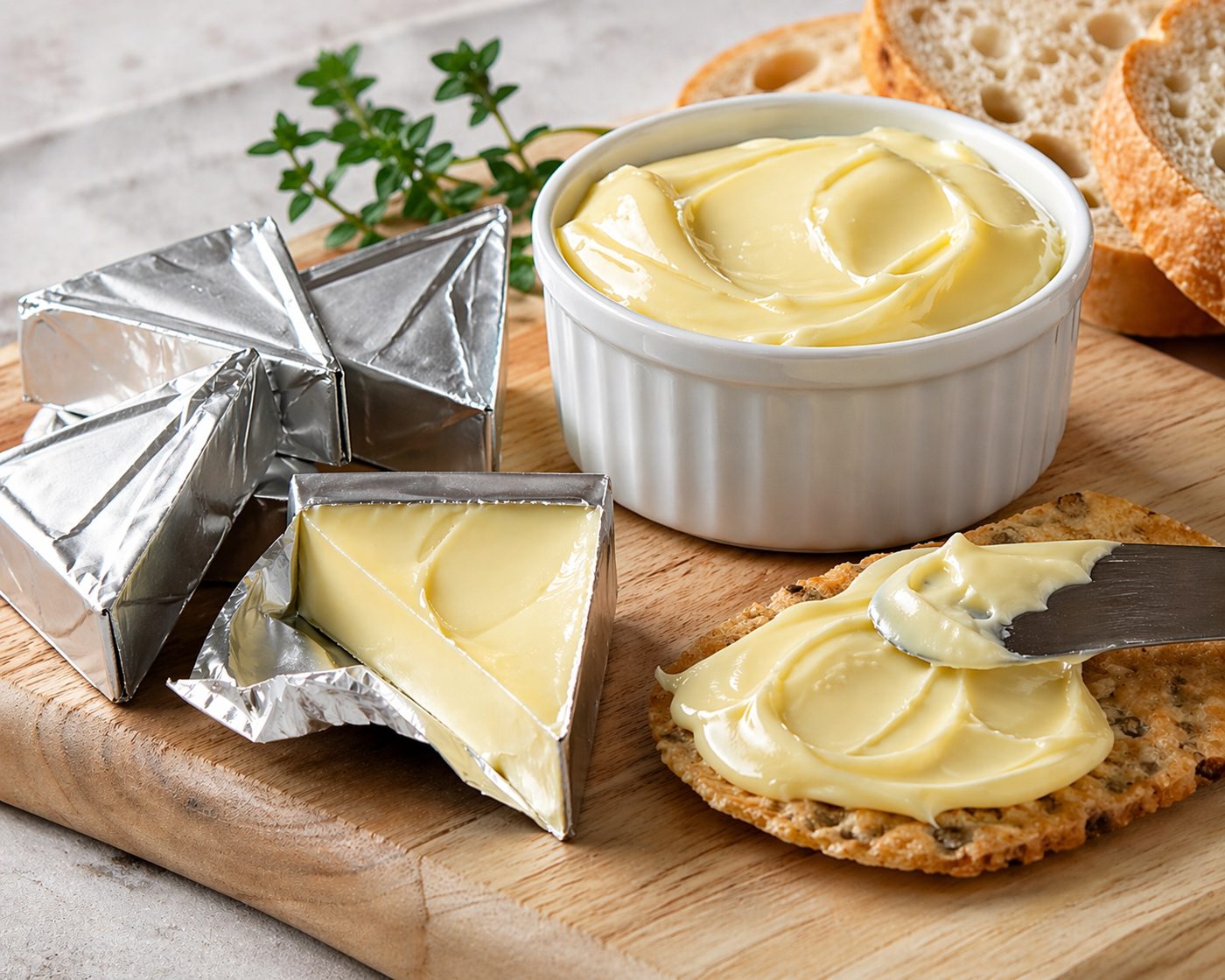
Spreadable processed cheese lives and dies by how the fat is emulsified. Whether the recipe starts from finished cheeses like kashkaval, white cheese, cheddar, emmentaler or gouda, or from fresh acid-set curd, the emulsifying salt has to pull the fat into a smooth, plastic mass without pulling so much calcium out of the protein that you lose the cheese itself. Technofood MS 91 is built for exactly this job.
Meet Technofood MS 91
Technofood MS 91
A blend of sodium phosphate (E339), diphosphate (E450), polyphosphate (E452) and trisodium citrate (E331). MS 91 is formulated with strong creaming functionality and weak ion-exchange capacity — two properties that together make it the right tool for spreadable processed cheese.
Why this balance matters
Strong creaming means MS 91 can emulsify and plasticise the cheese mass, building the fine fat emulsion that gives spreads their smooth, glossy body. The weaker ion-exchange means MS 91 does not pull calcium out of the protein the way long-chain polyphosphates do — which is precisely what keeps the cheese spreadable instead of firm.
How to Use MS 91
Processed cheese can be produced from a single finished cheese, a blend of several finished cheeses, or directly from fresh acid-set curd. MS 91 is at home in all three routes — the dosage and expected behaviour simply shift with the protein character of your raw material.
From Single or Multiple Finished Cheeses
Kashkaval, white cheese, cheddar, emmentaler and gouda-style cheeses are all valid starting points. The type of cheese drives the final texture, and what really matters is the protein quality — which is itself a function of pasteurisation temperature during cheese production and how long the cheese has aged.
As a rule of thumb: if your blend leans heavily on aged white cheese, the finished spread tends to have a weaker final texture — the protein has already been worked on by age. If you lean on fresh kashkaval or fresh cheese curd, you get a fuller, more structured texture. Knowing which way your formulation leans is the fastest route to predictable quality.
From Acid-Set Cheese Curd
Acid-set curd is a different animal — it is much less protein-rich than a matured cheese, so MS 91 plays a different role. Here the salt is used primarily to deliver creaminess to the finished spread rather than to restructure a protein-heavy mass.
The Right Dosage
On total cheese mass. Starting point for spreads made from kashkaval, white cheese, cheddar, emmentaler or gouda. Fine-tune by protein quality: young, casein-rich raw material may need slightly less.
A much lower dose is used because the curd is not protein-rich. Here MS 91 is chosen for the creaminess it delivers, not to restructure protein.
If the finished product becomes gummy and resists a spoon when mixing, the dose is too high — pull it back in small increments.
Managing Strong Creaming
Strong creaming is MS 91's strength, but in some contexts it also needs to be managed. In small to medium-sized factories, where production and packaging move quickly, strong creaming is rarely a problem — the product is shaped and filled before creaming can overshoot.
In larger factories with longer residence times, strong creaming can become a concern. For triangle cheeses in particular, over-creaming can cause the finished product to harden during shelf life, producing a brittle texture over time. Early batches may even look more viscous and attractive at the plant, yet show shelf-life problems in the market.
Watch the texture on the line: a gummy, spoon-resistant product signals over-dosing.
Watch the product at shelf life: if triangle cheeses turn brittle, strong creaming has gone too far during processing.
Young, casein-rich raw materials need a lighter hand on the dose than aged cheese blends.
One Salt, Multiple Formats
MS 91 is a versatile emulsifying salt you can apply across several spreadable formats:
- Tub or cup spreadable processed cheese — from finished cheeses or from a blend.
- Triangle portions in aluminium foil — the classic format; pay attention to creaming control in large-volume production.
- Acid-set curd spreadable cheese — at a much lower dose, optimised for creaminess.
One salt, three product categories — with dosage and raw-material choice being the levers that shape the final result.
Want a free production trial?
Reach out and our technical team will come to your facility, bring the product, and develop the application together with your team — whether it's triangles, tubs, or an acid-set curd spread.
Request a Trial